




Projects of Energy Community Interest (PECI) are priority infrastructure projects in the electricity and gas sectors that have a significant cross-border impact on more than one Contracting Party of the Energy Community. They are defined to support the development of an integrated regional energy market, enhance the security and reliability of energy supply, and enable the efficient and secure integration of renewable energy sources, in line with decarbonization objectives and the broader energy transition.
PECI projects are identified through a joint regional process coordinated by the Energy Community Secretariat, during which their technical, economic, environmental, and market benefits are assessed. A key selection criterion is cross-border relevance. Namely, the project’s capacity to improve interconnectivity between national energy systems, reduce network bottlenecks, and strengthen the overall stability of the regional power system.
The allocation of PECI status constitutes formal recognition of a project’s strategic importance. It enables enhanced institutional coordination among participating countries, accelerates project preparation and implementation, and facilitates access to international financial instruments, technical assistance, and support from international financial institutions.
MEPSO’s Role and Application for PECI Status
As the national transmission system operator, MEPSO plays a key role in planning, developing, and maintaining a secure and stable transmission system aligned with regional and European energy policies. Within its strategic mandate, MEPSO continuously works to strengthen cross-border interconnections and modernize the transmission network, aiming to better integrate the national electricity market into regional and European markets.
In this context, MEPSO has applied for PECI status for the project “400 kV East–West Interconnection Corridor – Western Section”, recognizing its pronounced regional relevance and its direct contribution to achieving the objectives of the Energy Community, as well as national goals related to secure and sustainable electricity supply.
Project Description
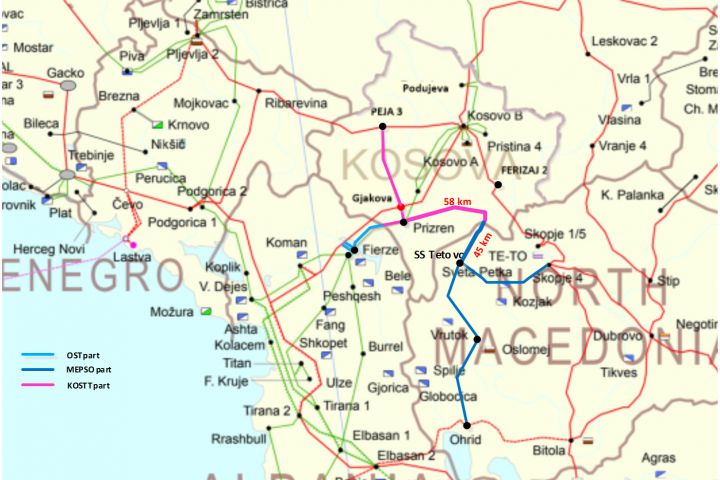
The 400 kV East–West Interconnection Corridor – Western Section project envisages the construction of a new 400 kV interconnection transmission line Tetovo–Prizren, which will reinforce the internal transmission network of North Macedonia and establish a new direct connection with the power system of Kosovo. The corridor connects Skopje and Ohrid via Tetovo, with a cross-border interconnection towards Prizren (Kosovo). The total length of the Western Section is estimated at approximately 255 km.
The project is structured as a package of interrelated investments, including the construction of new 400 kV transmission lines, new 400/110 kV substations, and the expansion and adaptation of existing lines. A key component is the construction of a new 400/110 kV substation in Tetovo, which will serve as a central hub for multiple 400 kV lines and significantly strengthen transmission capacity in the western part of the country.
In addition, the project involves the potential construction of a new 400/110 kV substation in Oslomej, enabling improved integration of existing and planned generation capacities, such as renewable energy sources, and providing increased operational flexibility for the system.
Regional Dimension and Complementarity
The new 400 kV Tetovo–Prizren interconnection is a critical link in the regional East–West corridor and strengthens cross-border connectivity among Macedonia, Kosovo, and Albania. The project is directly complementary to the already approved PECI project to upgrade the Kosovo–Albania transmission corridor (Prizren–Fierza) to 400 kV. Together, these projects form a continuous and robust regional transmission corridor.
This integrated approach enables secure and flexible energy flows across the Western Balkans, improved utilization of existing and future generation capacities, and enhanced resilience of the transmission system under disturbances and extreme operating conditions.
Expected Benefits
The implementation of the project is expected to deliver multiple benefits at both national and regional levels, including:
- significant improvement in the security and stability of the transmission system;
- increased cross-border electricity trade and enhanced market integration;
- reduction of network constraints and improved operational flexibility;
- creation of the necessary conditions for integrating large-scale renewable energy capacities;
- support for long-term decarbonization objectives and the sustainable development of the energy sector.